Monday, November 11, 2013

Spanish Moss


The gray material hanging from the oak trees in the lowlands is a plant known as Spanish Moss.   But hold on, it is neither Spanish nor Moss... but rather a relative of the pineapple called : Tillandsia Usneoides.  


It does produce flowers, tiny ones that can't
 be seen from afar.  Spanish moss is an Epiphyte…that is a plant which gets all of its nutrients  and moisture from the gases and water particles in the air.


In no way does it harm the plant which it hangs from as it is not parasitic like real moss.   It can't live on the ground, though. 


 It prefers dense wood and strong branches like the live oak, the swamp cypress and crepe myrtles.  It will be spotted on these but not the pines a few feet away.


Spanish moss is native to the South's humid semi-tropical environment.  It doesn't surprise me to see it hanging on this pyracanthus though…tough little bugger that it is. 


photo by Ken Schwarz
 It is one of the things about the South that make the landscape so graceful and yes, languid….. pleasantly lazy and peaceful?

Sunday, November 10, 2013

Palmetto and the Carriage Ride

The Carriage ride in Charleston was great.  I know ... I know, that's for tourists.  But hey, that was us. 

  We had the absolute funniest and best informed guide with the Palmetto Carriage rides.   Don't get me wrong the houses and sites were interesting too,  but Dave and I had already "ponied up" to visit six historic houses with the Preservation society one evening and we delved pretty deeply into architecture and the history of the old homes both in Charleston and all the way through the South.   So the carriage ride was more for the fun of it. 


What was really interesting to me was the Carriage tour industry itself and how that operates.  We used a company called Palmetto after the tree which features on the flag of South Carolina.  Our  carriage mules were named Hit and Run , were brothers, and were inseparable from birth…. although constantly fought throughout the ride.  


These guys reminded me of our Mules, as they are also nipping each other .

  The Palmetto tours are pretty careful about buying old work horses and mules and taking them out of circulation to the countryside to graze for several months at a time.   They say that the absolute weakest work horses are the Clydesdales only made famous by Budweiser and never used in Charleston because their lack of stamina.    After every trip the horses' temperatures are taken ... yeah, like you imagine….up the yin yang,   so the company can make sure the teams are in good health and not too overheated or ill. 


 Here's how I saw it… oh was it supposed to be about the houses, the churches and the cobblestone streets?


the French Percheron, a good sturdy worker


Why not some chickens to keep the horses company


As this sign says…. they have a live webcam in the barn, the animals average 18 weeks a year on the farm , the company goes through 2000 horse shoes a year , 60 tons of feed etc. etc. 

 It sounds alright to me but then I am not a horse. 

Ok, here are some views of the streets of Charleston: 


This roof looking very French, wouldn't you say?


The Arthur Ravenel Jr. Bridge


I know I promised to bore you with my photos of my trip but I have been busy editing my garden.  The gardener can't go away for 3 weeks and not expect things to riot.   And Monsieur has his own riots to quell, i.e. business! 

 In the last few days I have taken out nine large bags of clippings from the studio garden and my own patch.  I have to cut back the grapevine and I have been tackling the many thorned Pyracanthus and have the scars to prove it. 


  I count gardening as therapy so I'm not complaining .  I would rather be outside then in when there is Autumn in the air. 


To continue the story of my trip to The Lowlands,  the third week I met up with my brother, Dave who had flown into Savannah from Oregon.   We started out in Charleston since he had not seen it and there was plenty to do.


 We did do some of the touristy things like take the carriage ride and the harbor boat tour which are highly recommended for newcomers.  


The latter was more fun than you might imagine, seeing the landmarks from a different vantage point and hearing jokes about local pirate lore.  


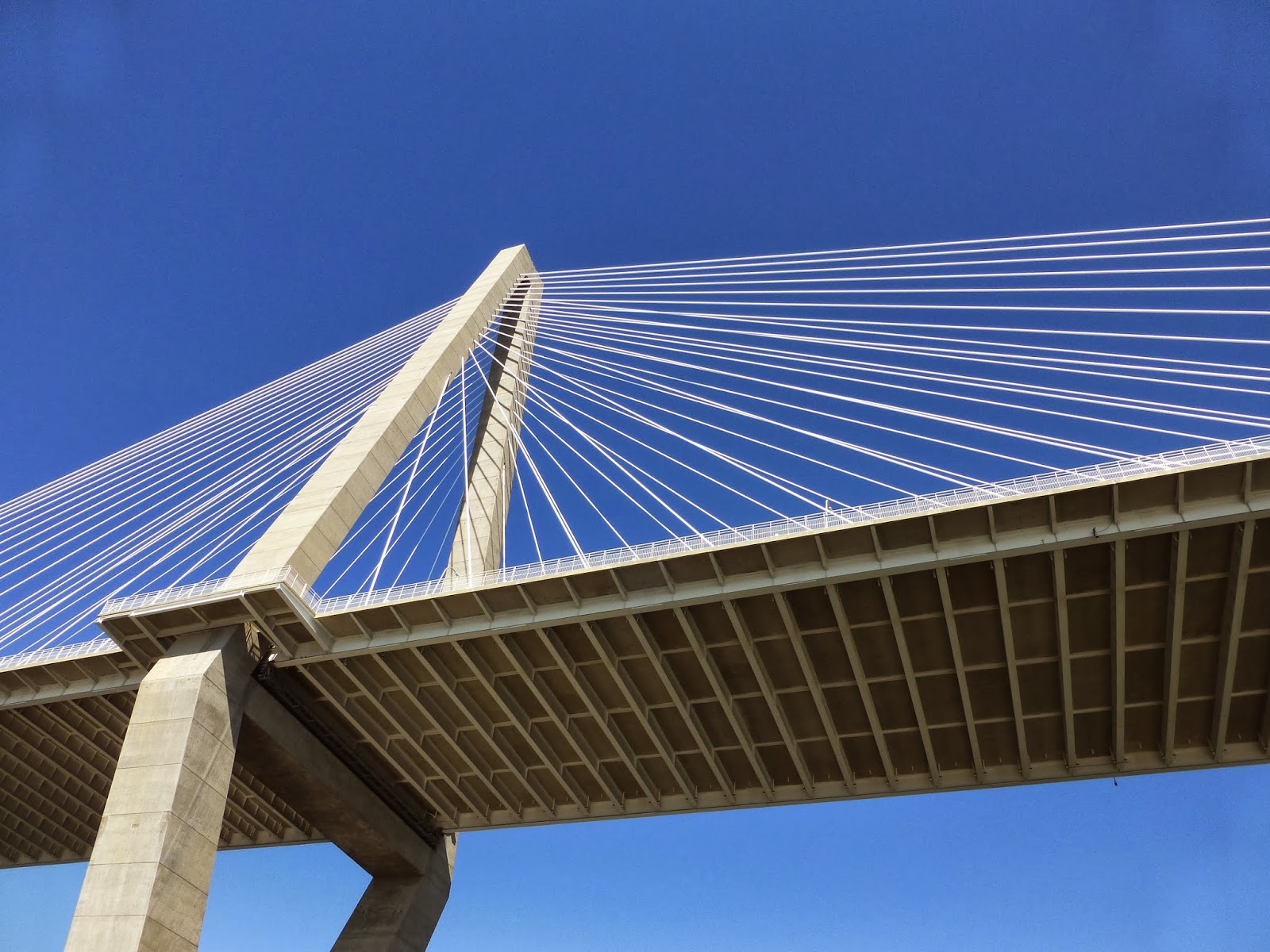
I was rather more taken, however, with views of the Arthur Ravenel Jr. Bridge (or the New Cooper River Bridge).  


 It is the bridge I had crossed several times while visiting South Carolina as it connects my friends in Mount Pleasant with the rest of Charleston. 


 It is an eight lane bridge built in 2005 to replace two worn out cantilever truss bridges and although not as impressive as France's Milau Viaduct, (it is a small bridge by comparison) it is as attractive as it is necessary. 


 As our boat passed before and under it I got these shots. 


 There is also a lovely parkway pier built underneath it where one can swing three abreast; reflect on one's brilliant life; and/  or fish:  three of my favorite pastimes.


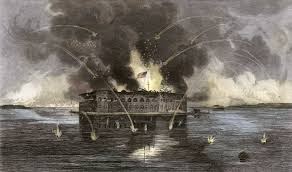
And here is what's left of Fort Sumpter where the first shots to start the American Civil War were fired.  


 I grabbed his shot from the web. of how it looked before the walls were destroyed. 


Thursday, November 7, 2013

Charleston: The Holy City


Wadmalaw Island,

This is random information from wiki. that I picked up about Wadmalaw Island, ( accent on the first syllable)... one of the barrier islands  I visited near Charleston while with Ellen.

 One of the things I liked most about this trip was that the history of the place is in evidence all around you… You can see that this island was claimed for England in 1666. 

Wadmalaw Island was landed upon by Captain Robert Sandford and the crew of the Berkeley Bay in mid-June 1666 after an excursion up the Bohicket Creek. It is believed that Sandford landed where Rockville, South Carolina now sits. On June 23, 1666, Captain and crew carried out the ritual of turf and twig, claiming the land for England and the Lords Proprietors.

In 1670, 148 colonists arrived and settled on the west bank of the Ashley (Kiawah) River. They survived the first four years of poor crop production through the generosity of natives who shared beans and corn. They later moved to what is now Charleston.

In 1890, planters organized the first sailing regatta at Rockville, less than a mile from the tea plantation. The 120th Rockville Regatta was held in August, 2010.


Here are some pics of our visit to Ellen's friends' home where we enjoyed a wonderful lunch.


and yes, those are baby figs in there…


Shrimp creole with bell peppers….an excellent dish


Ellen and I "horse around" on the dock…  ( when I put something in quotes, its usually because I am thinking of my non- English speaking readers!)


low tide and the oyster beds are showing…and there was a heron slipping out of sight


the area has clams and oysters to dig…plenty of shrimp and fish


A view from the house…


 I never got enough of the sheer beauty of the lowlands with its unique land and seascapes, its marsh lands .  The scene changes with the tides by the hour and the colors with the seasons.   

And I can not take for granted the simple pleasure of southern hospitality. 


Madame's House

For years I have called her just "Madam"  or "darling".   Others refer to her as Auntie Mame.  I haven't read the book or seen the movie so I can't say if that fits,  but Ellen and I go back 25 years from our first meeting when we lived in San Francisco.  She has visited Monsieur and I at least 15 times in England, Italy, France and even Spain so it was strange that I would wait so long to visit my good friend's home in the south.

But sometimes, life intervenes…..

 Let me take you on a tour of this collector's treasure trove, Madam's Charleston home. But let me explain:
  Ellen lives in what was called the kitchen house. In the plantation era, a "kitchen house" was a separate dwelling next to a huge southern home, used by the "help"( i.e. slaves), to fix the food for the main house. Many of the plantation owners kept large dwellings in Charleston and there are still some of these kitchen houses to be found in the historic district.  The "big" house that was adjacent to Ellen's property has long since been destroyed.  If it wasn't one of the fires, or sieges of war,  it was just old age that killed it. 

Before we start, I want to point out that many of the paintings in her house were bought at flea markets or antique fairs ( especially in Nice) while we were together.  And I proudly note that there are 9 of my art works in the house too.  It was lovely to see them again, and this time, framed!  

Again, within one week,  I felt like I was staying in a five star…. this one a "bed and breakfast inn". 


The entry through one of two doors from the garden.


The parlor


The great wall….(I know the provence of 16 of these paintings. )


Two of the paintings in this photo are my oil sketches done with a palette knife, can you guess which ones?  Madame seized them from my sketch book and we bargained just like we always do at the flea market. 


In case you want to know, I did this one, "the nude", and "the pear and carafe" sketch.


There are lots of buddhas and mirrors in this place. 
 Ellen's father ( an engineer by profession), made all of the curtains for the house. Each curtain is lined with contrasting brocade or silk from fabric lovingly chosen in France or Britain. 


The dining room has a gas fireplace.


The painting "en bas" is a Van Gogh copy that I did and had framed in Nice.  


                                   The upstairs sitting room .  


the master bedroom….


and bath...


….hey that's an original I painted. ( I can't get over seeing my work on a wall in Charleston!)


The guest room  ( my room) with a view out over the trees in front.


I had fun capturing the many "still lives" that I found throughout the house, Madame's little objects….  I just wouldn't want to dust them.


  Well, darling, I will be back if you please.  Save my room for me.