Thursday, July 2, 2015

Wool Festival: Cumbria 2015

Showpiece robe commemorating the year of the Sheep, Photo by Mary M Payne, Cumbria wool fest
Shown in one of the sheep shearing demonstration pens. 

I just returned from a visit to the Cumbrian Wool Festival in the lovely lake district of England.    I went especially to see some London friends and this was a singular invitation to go together to the festival and to stay in their house in Cockermouth, near the Scottish border. 

What is a wool festival?  Well, actually.... I found out what the Cumbrian Wool Festival really is not.  It is not about machine processed yarn.   None of the mainstream commercial yarn vendors were present. All of the yarns represented were hand dyed and spun. 

In fact, the festival in Cockermouth is more about the rich culture of raising rare breeds of sheep and the creativity and crafts that are derived from their wool.

 That means that there were stalls with yarns, spinning wheels, carders; unusual buttons; hand made rugs and clothing but also hand crafted  beads and fasteners; antique fabric pieces and  woodworkers making spindles, needles and wheels.  


 And of course , there was food and local country  music .    


And there were bags of wool, wool and more wool.   

Not to mention the sheep themselves...
special ones, appealing ones all quite different from one another....as well as alpacas and angora rabbits.


Hand crafted  wool settee and pillows, photo by Mary M Payne


 Valais Black Nose Sheep  Photo by Mary M Payne Cumbrian Wool Fest


Local basket maker at work  Photo by Mary M Payne  Cumbrian Wool Fest

The Portland is a heathland breed from the Dorset area linked to
the Wessex tan-faced group of sheep.  Photo by Mary M Payne

My best photo...he's lovely, non?  Photo by Mary M Payne, Cumbrian Wool Fest


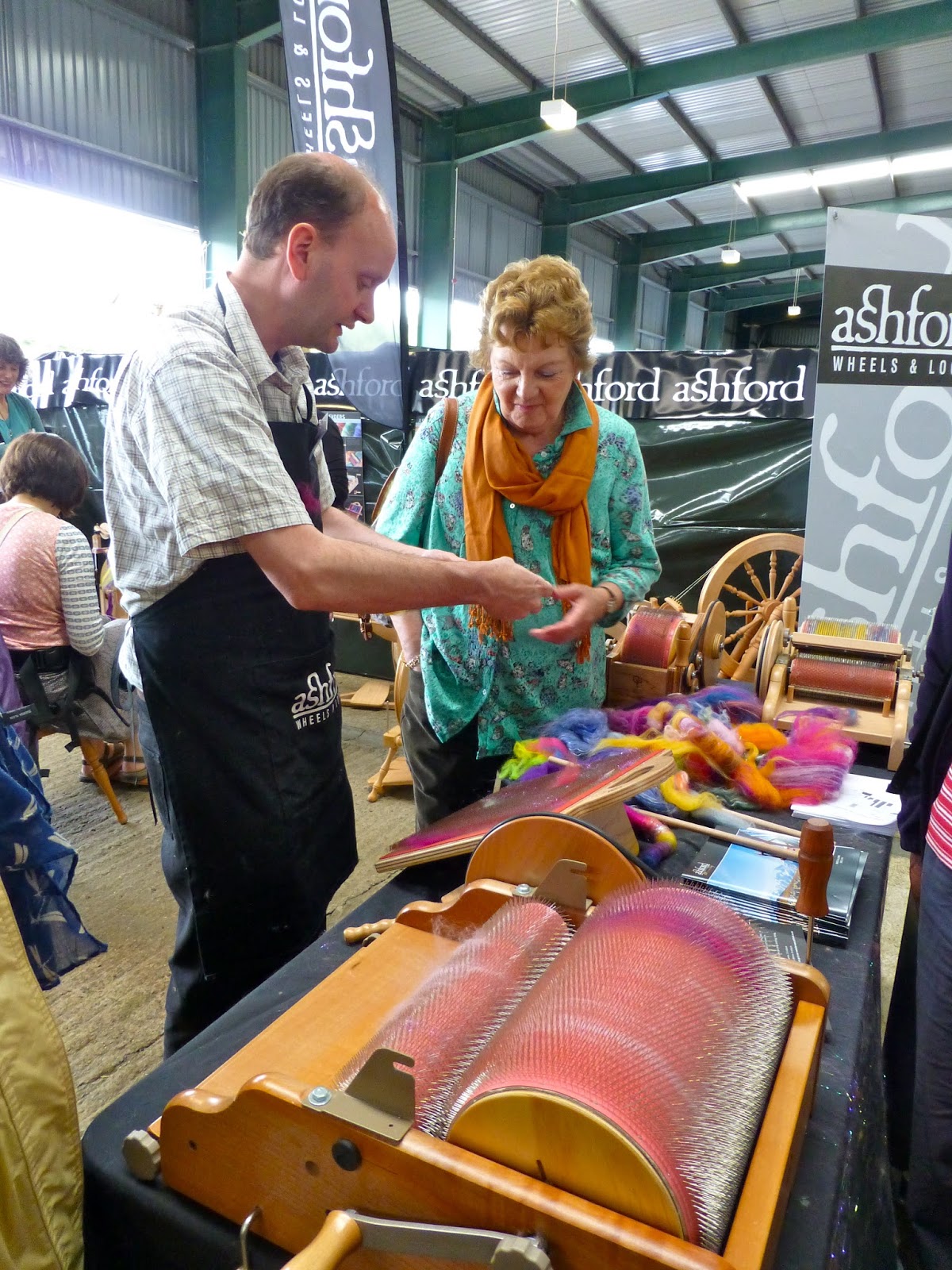
A fellow demonstrating a carding machine making batts ready to spin.  This is how the variegated yarns can be made by adding bits of different colors to the mix  Photo by Mary M Payne, 


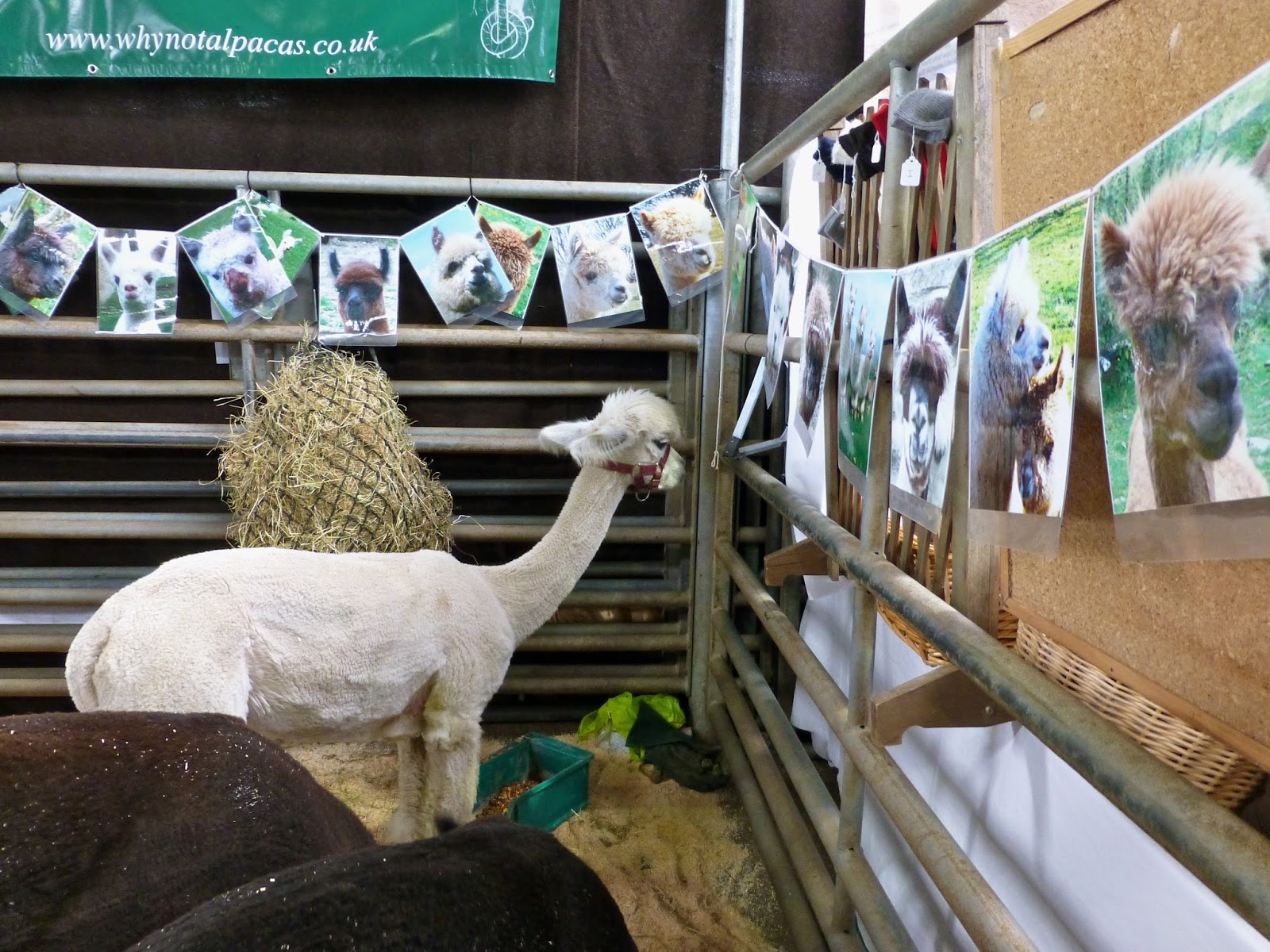
One of the Alpaca boys (called Alpaga in France).   Photo by Mary M Payne


Teeswater Sheep with unusual lustrous coats .  Photo by Mary M Payne


He needs a scrunchy.  Photo by Mary M Payne


Angora Rabbits used for their fur.  Their fur is sheared or combed to use as yarn.  Photo by Mary M Payne


Woman trying her hand at spinning  Photo by Mary M Payne Cumbrian Wool Fest


Mary had a little lamb....  Photo by Mary M Payne


Wool ready to card or use for felting or stuffing..Photo by Mary M Payne


Silk and wool blend yarn I bought from Natural Born Dyers, photo by Mary M Payne, Cumbria Wool Festival

The show was fascinating and I did come away with luscious wool for knitting. ...but mostly I was enthralled by the variety and originality of the crafts and people involved.   Crafters are themselves a special breed.  

Wednesday, June 24, 2015

In Bloom in June

I am killing time before my flight to Cumbria.    So here is a quick peek of the glories of my little garden mid June....before I set out.  


The trumpet vine in memory of my father who was fromVirginia where these vines grow abundantly in the trees.


White petunias from last year that came back.   The punk spikes are Celosia. 


Purple Lobelia and  Ageratum houstonianum. 


New leaves on Cycas ( Sego Palm in English)


Three whites:  Petunia, Lobelia and another unidentified.


Monsieur's cutting of a hanging begonia under a  dwarf maple tree


Blue Delphiniums

Wednesday, June 17, 2015

Some say the world will end in fire.....

Ok, so it has been a couple of weeks now that I did the deed of "daring do" as regards to the Asian frelon ( hornet) in my garden.    

Monsieur and I both noticed that the coal tits had not made their habitual visit to our nesting box ( nichoir) this year. 

Coal Tits are common in our area.  


 On observation of the box I found out why.  There was an impressive "bee-like" insect going into the box.   It was over an inch long! 


 Asian Hornet : Photo by ign.com

 Luckily it had left me alone when I had been trimming the bay tree. ... where we had our  nesting box wired.    I got right down from the tree and "googled" it. 

 What I found out made me "mad as a hornet"  because I am pretty sure, that being carnivorous, the Asian hornets had already destroyed the wild honeybee nest .... the one that has been on our property for over 20 years...the one that each year produced several swarms and who's residents enjoyed the pesticide free garden I have created. ...BECAUSE ASIAN HORNETS EAT BEES! 

The "bee guy" that we had called from "S.O.S. Assaim" has profited from our swarms of bees for several years now.  He would come with his assistant and load the swarm into a new home.   It was he who had told us that our hive was a combination of wild and commercial honeybees.  And now they have disappeared probably due to the Asian hornet. 


So I sent a mail to a local association in France dedicated to controlling the Asian Hornet and asked how to go about eradicating the hornet's nest  without using poison.   

 A helpful fellow wrote back a week later and said that I should put on two layers of clothes, a helmet with a net and stuff a wet paper plug into the hole of the nichoir. ...then put it in the sun until the beasts were dead. 

  But hey, he was a week too late telling me this.  I had already decided to act before I heard from him.   I didn't want the nest to get bigger and I didn't want offspring starting to be produced. 

 As far as I could tell from observation, the activity was from a single hornet coming and going and her movement stopped in the evening and didn't start until around 10 in the morning.  

So I waited until a friend was here ( Monsieur was away), then I climbed the ladder early in the morning ( without any protective clothes).  Yes,  I made sure my friend was around in case I had to be rushed to the hospital.  These insects can sting multiple times and have been known to kill people...(at least in China! ) 

 So foolishly perhaps, without any special clothes,  I  sealed the box with a piece of strong packing tape in one swift movement.    I then took the whole box down out of the tree with the hole taped up. 

 I listened and something was moving inside.  I had at least one hornet  

.....but how to kill this evil queen.  

  I thought of Robert Frost's poem.


Fire and Ice by Robert Frost
Some say the world will end in fire,
Some say in ice.
From what I’ve tasted of desire
I hold with those who favor fire.
But if it had to perish twice,
I think I know enough of hate
To say that for destruction ice
Is also great
And would suffice. 

Frankly,  leaving it in the heat to die seemed more cruel than the second option. .....so I cleared out the second drawer of the freezer and put the whole nichoir in there for four hours.  Clever me!  

Finally I had enough nerve to open it.  And here is what I found:   the paper nest was only about 10 cm across.   Whew, I had gotten it early.  And there was just a sole hornet. 
Photo by Mary M Payne


 Next year beginning in February,  when the nest building starts, I am going to devise a trap for the hornets.    I can't support this bee eater in my garden again and I want to do my part for the bee population! 

      I hear hornets like beer or wine and that is what I will put in my "piege". ...maybe wine since after all, we are in France! 

Monday, June 15, 2015

Bike : Chine collé


Chine Collé with Michelin Guide: Mary Payne


 As I have explained in an earlier post,  Chine collé is a technique in which one can affix a piece of paper ( usually colorfast Japanese tissue paper)  under a print so that it becomes the background as the print is laid down. 

Being in France, old Michelin guides are easy to come by so I cut up a piece of the map and glued it with traditional glue starch to make this print. My plate had already been prepared as an aquatint of a bike and shadow inked in black. 

Just the printing process required that I:

1.  Wet the paper and the map thoroughly and set it between two sheets of old newsprint to soak for 10 minutes. 

2.  Inked my copper "plaque" with oil based black, wiped it with three different pieces of tarlatan and hand wiped the plate and set it aside. 

3.  Soaked the BFK Rives receiving paper for about 10 minutes,  dried it with a towel on both sides until it was damp.

4.  Spread glue with a brush... onto the damp paper surpassing the area of the print.  

5.  Removed the damp piece of map and placed it face down on top of the inked copper plate. 

6.  Centered the plate on the press and then measured off the amount of margin I wanted on each side in order to center the paper. 

7.  Dropped the paper on top of the plate (and map piece) and placed the blankets ("linge")over the whole. 

8.  Turned the crank on the press to run the plate through the press. 

9.  Slowly peeled back the paper (in case the glue was not adhering to the paper) and pulled off the print. 

The second time I tried the traditional paper which  is finer than traditional tissue paper to be used under the inked plate.  This time I spattered it with ink before using it.  Next time I will use a wash of acrylic instead of ink because that will not mix with the glue.  I was being absent minded again when I grabbed for the ink.   Also I needed to dry the finished print between two sheets of blotter paper under a pile of books for at least a week.  I didn't do that either and so I have a ripple in the middle.  I will have to rewet it and try again.  Print making teaches Buddhist "mindfulness" if you stay at it long enough. 

Chine collé : Mary Payne


Sunday, June 14, 2015

End of Year Evaluation : Gravure


It is a lazy Sunday and there is a noisy summer storm in progress.  I have the summer off from the printmaking class and I am in the process of looking through what I have produced...  seeing what was successful and what was not. 

   Examining the finished work,  I can see that there is room for improvement and some prints I will try again.      Too bad archival paper is costly....as it is difficult for me to actually put prints in the "poubelle".   However,  if I were doing an edition for sale , many prints would most certainly end up as trash.   


The biggest problem I seem to have in my current classroom situation is "impatience".     The large press in the studio at school is coveted by all the students as it takes large paper (preferred for exhibition) and is more accurate for lino prints than the book press we have at our disposal.  But though the large press prints both metal and lino, the instructor is reluctant to re-regulate it for each new class every three hours. 


To print linoleum blocks on the large press,  it is required that one  take away the blankets and substitute runners the height of standard linoleum.  The instructor must also change the tension on the press.  Since she is the only one allowed to make these adjustments, it is up to her if we get to print our preferred plaque at class each Wednesday.  


  I think when she puts on the "green light" for us "lino" students to use the large press....I get excited to do as many as possible. 


Lesson number one:   Slow down and concentrate on each print each step of the way. ...  better to do just one then have to throw some away.


I have a single two toned print to show you today.    This is taken from a gouache painting I did years back and I intended to make it into a linoleum reduction print.   However, I found that the size of "lino" I had chosen to work with this year was too small for the number of details required and the number of colors I wanted.  


Painting by Mary M Payne
 I have carved the painting as a simple lino and printed it below in a two tone print about the size of standard French A4 paper.  The coral color oil based ink went on and dried for a week before I put over the black layer.  

 It is also difficult to roll out two colors at school as we have a very small glass area that everyone shares.    Otherwise I would have tried "wet on wet" which means printing the black immediately after the background. 


 I reversed the print on this design as I didn't feel that was critical to the result.   I have experimented with several new techniques this year.  This one reminds me of a silhouette ...as done by paper cut artists like Kara Walker.   http://learn.walkerart.org/karawalker


Linocut engraving by Mary M Payne


Monday, May 18, 2015

Ah, what a Cathedral


Cloister, Durham Cathedral,  photo by Mary M Payne
I am back at the Cathedral and talking to Brian Peaden who speaks to me as I am admiring the archways and shadows.  He is a retired local and a member of an amateur photographer's group.   He sees that I am taking a photo of the cloisters but missing the secret. 

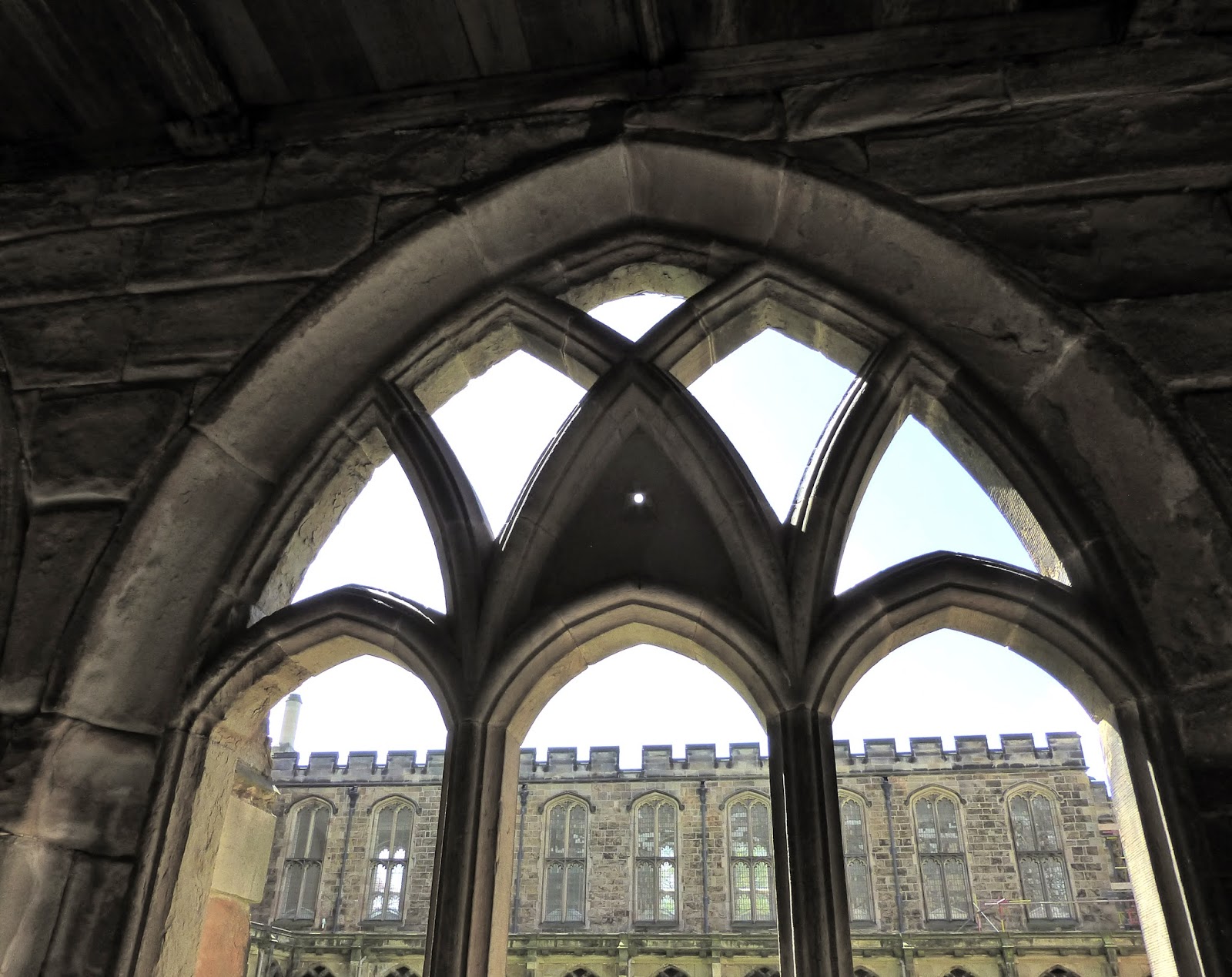
  I have been oblivious to the little hole inserted into the brick at the top of the archway that makes up part of a sundial formed on a meridian line and Brian explains it to me.  

Brian  Peaden 
A Meridian line (meridies : Latin for midday) was drawn in the cloister in 1829 by the then headmaster of Durham School : Dr. Carr and William Wharton of Dryburn.    A piece of stone in which there is a circular opening ( with a thin edge) of about an inch... has been inserted into a piece of stone at the top of one of the archways.  You can see that in my second photo.  

 Near noon, the sun is almost directly opposite the hole and the light streaming through the hole falls onto the pavement below.  When the sun is low (as near the winter solstice), the light will fall on the opposite wall where there is another sun dial.  

" by observing the time of the first contact of the circular spot of light with the meridian line, and also the time of last contact and taking the mean, I have found that the instant of apparent noon can be ascertained within a second of time"   says the late Rev. Temple Chevallier. 

 Hmmm.  Sounds like something that would interest Ian. 

If you look closely you can see the sundial on the floor at the left edge of the photo.  I think it must have been about 11am when I took the photo.  


Cloister showing meridian hole  photo by Mary M Payne

Shadow showing meridian hole and sun dial to far left  photo by Mary M Payne


After this little discovery,  I plunge back into the imposing interior of the Durham Cathedral, "the largest and most perfect monument of the Norman style of architecture in England." 

 And besides being the film realization of Hogwarts school of Wizardry has a most astonishing history full of intrigue, politics, imprisonment, and death.   Read it here: 
http://en.wikipedia.org/wiki/Durham_Cathedral


This time the sanctuary is calm and I stay a while.   I light candles for Monsieur and I..... as today is our Anniversary and for Josh III whose birthday is today.... May 11.   I am not a church goer myself,  but I do love the candle ritual. 


Main Entrance and west side of Durham Cathedral  photo by Mary M Payne


Gravestones in front of Durham Cathedral  photo by Mary M Payne

Gravestone statuary at Durham Cathedral  photo by Mary M Payne


Eastcorner of Durham Cathedral facing entrance,  photo by Mary M Payne
Museums and libraries facing on Durham Palace Green  outside of Cathedral photo by Mary M Payne
 After leaving I look around the outside at what is today known as Palace Green.   It was once the city market place and undoubtedly was rather chaotic and noisy.... not calm as it is now.   Surrounding the green are buildings of different periods:  These include Cosin's Almshouses, Cosin's Hall, Moneyer's Garth, the Palace green Library and the Music School.  There is the Abbey House as well with remains of medieval fortifications and the Master's House of Durham University. 

After a peek inside some of these,  I head down the pavement through the old town to find lunch.  

I settle on a cafe serving a "club sandwich" which is not a dainty little thing.... but huge and full of ham, chicken and cheese enough to feed four.   But, alas, there is no salad, no tomato, no lettuce with that.   
 I read later that the price of vegetables and fruits has increased 90% in Britain while the price of industrial food has gone down 20%.  Yipes. 

After I do another spin around town,   I decide to head back down the river path to call Monsieur , to wish him a happy 24th Anniversary and watch the river scene. 

Old mill on the  River Wear  Durham,  photo by Mary M Payne
Durham Cathedral from River Wear  photo by Mary M Payne

   I decide to end the day back at the botanical gardens. 
   The indoor cafe at the gardens offers botanical books which I scan while I enjoy a piece of lemon drizzle cake.  Yes,  I have at last found what my craven "sweet tooth" was looking for. 

With the flower book , tea and cake,  I find a tranquil corner and  identify.... the "forget-me-nots" I have been seeing everywhere in the verges.  They are also showing local art on the walls.  
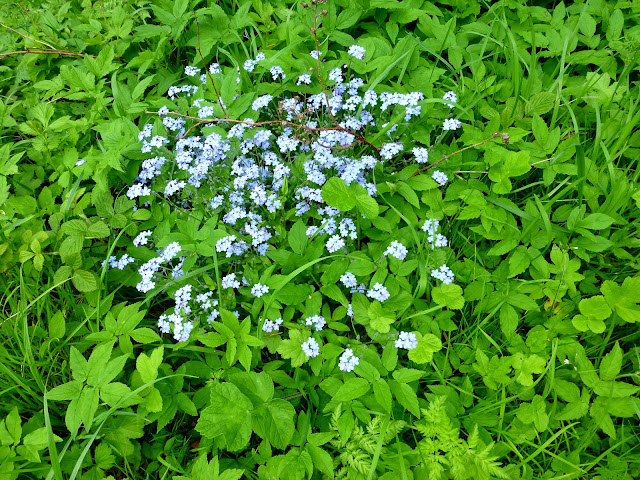
"forget-me-nots"
   New discoveries and new thoughts.... that's what makes up an inspiring vacation....  and the people you spend it with,   that's so true. 

"I wandered lonely as a cloud"  photo by Mary M Payne

 Now its home, down the footpath, to my lovely, lively friend Leslie and her family and tomorrow I'll be back in Nice. 

This is an English lawn...how enchanting.  photo by Mary M Payne

Sunday, May 17, 2015

Botanical Gardens

Its my last day in Durham and I have decided to go to the Botanical Gardens of the Durham University and then back to the Cathedral.


   On the way I will pass some colleges of the University.  


Ian, with whom I am staying,  is a math instructor at the University.  I should say, in truth, he is a math wizard and just happens to be a popular professor .   I would not even be able to talk to him on the level of his abstruse subject.  I might as well try to speak a dialect of Ethiopia.   But luckily for me,  you would never know this unless you knew that his mind operates like this.  It is easy to speak to him. 

 He informs me that all of these different colleges that I see on the "campus" are really just communities of students who live and commune together, as constituent parts of the larger university...a bit like a dorm.  There are not actually instructors giving different classes at each college.

  It is completely different from the system in the United States or France.  In the U. S.  the word "college " is used interchangeably with "university".   In France it is different still:  a "college" refers to a junior high school where you will find young people 11-15 years old. 

  There are some beautiful colleges in Durham.  My favorite of those I have passed is St Mary's College.

Stone marking the college of St Mary's   photo by Mary M Payne


Walkway to St Mary's College, Durham  photo by Mary M Payne

 I take the footpath past it to the Botanical Gardens.... seeing many  students on the way.    I pass a flowering cherry tree not realizing it will be the only flowering tree I see that morning. 


Cherry tree , Durham   photo by Mary M Payne

The cherry looks out over this lovely view of the distant Cathedral. The view could be the subject of a John Constable painting.

Durham Cathedral,   photo by Mary M Payne

At the Gardens, I ask for and get a "troisiéme age" discount known  as  a senior discount.  Troisiéme age is what it is called in France.    I sort of like that , it gives one a sense of entitlement for getting this far in life and it denotes a" do-over", erasing all the failures.   Start over in your third age, good idea...everything else has changed!  

The grounds are lovely in the Botanical Gardens.   But except for a few magnificent pots of tulips, NOTHING is blooming today.   I guess I kind of expected flowers so I am temporarily disappointed.   And the promised sheep in the pasture of the gardens were removed in March. Humph.  
 

Pots of tulips, Durham Botanical Gardens,  Photo by Mary M Payne


 But there are some lovely walks,  and best of all there is a WIND.  The magnificent trees in the park are singing like a chorus of wild things.....which I suppose they are.  I picture all of the tree spirits drinking wine and playing cards and generally wise cracking.  It is more than soothing, it is cacophonous.   Still I love sitting on one of the many memorial benches and don't want to budge.  A gaggle of young school children go by with their teachers, but no one else.  

 But finally , the Cathedral is calling to me again.  I must go and give it some more time. 

Tree spirits communing..Durham Botanical Gardens  photo Mary M Payne