Thursday, March 5, 2015

The Bay of Villefranche sur Mer


Photo of Villefranche Bay by John Puckett

One of my faithful readers has let me know that there is more to the story of the name of Villefranche sur Mer than "a French city by the sea".  

 Villefranche Bay is one of the deepest natural harbors of any port in the Mediterranean. 

  Because of this fact,  the town of Villefranche sur Mer has become an important port over the years and can provide safe anchorage for large ships, reaching depths of 95 m(320 ft) between the Cape of Nice and nearby Cap Ferrat.  There is, as well, an undersea canyon at about one nautical mile off the coast.  
 
Because of these natural assets , the US Navy regularly used the port of Villefranche for its Sixth Fleet between 1948-1966 .  At that time, however,  French President Charles De Gaulle withdrew France from NATO and took away that privilege. 

 However,  from around the years 2000, I was invited to the Niçoise annual July 4th celebration for four consecutive years. 

  This was by way of thanking me for volunteering to help teach English at the club then called   "France/Etats Unis".  Each year that I was invited,  the officers from the American Naval Sixth Fleet were in attendance dressed in their impeccable white uniforms.  I even danced with some of them to the swing tunes of the talented band composed of local "Pompiers" (firemen).  It was during one of the stints when Jaques Peyrat was the mayor of Nice and he approached me and asked me to introduce myself when he saw me start up the dancing. 

 The officers' ship was stationed in the Bay of Villefranche sur Mer they told me. 

  There is a long and complicated relationship with France and the US concerning NATO....so perhaps this was just a gesture of goodwill at the time.  Maybe one of my readers can tell me how this came to be. 

  Since the 1980's,  I understand that that bay is used only for cruise ships.  In fact Villefranche Bay is the most popular port-of-call for cruise ships in France and one regularly sees them stationed off of the coast when one passes on one of the three roads or "corniche" that run through the mountainside of the town.

But back to the name of that small port town, Villefranche sur Mer: 

 During the late 18th century, Villefranche lost some of its maritime traffic to the new Lympia harbor being dug in Nice, although still remaining an important military and naval base.  


Photo by John Puckett: Villefranche sur Mer


But even before that time the city had its present name.    "In 1295, Charles II, Duke of Anjou, then Count of Provence, enticed the inhabitants of Montolivo and surroundings to settle closer to the coastline in order to secure the area from pirates."  (wikipedia) forming a village at the sea. 

 Then Charles II established Villefranche meaning "free city" a tax free zone giving it its present name.  The tax privileges and lower port fees Charles II established were to compete with the port at Nice even before it was dug out to the size it has become today. 

These tax laws lasted well into the 18th century. The project of digging the new enlargement of the Lympia port of Nice itself began in 1748 with King Charles-Emmanuel III and continued for a century and a half till its completion.


Wednesday, March 4, 2015

Mozzi has a girlfriend


Mozzi has a girlfriend.  Being a castrated male,  I have no idea if he knows what to do with her. 

 But he seems to like using my pink sweater for a female , biting it and "overtaking" it's lushness in a stupor of domination.     So maybe he still knows what to do. 


Mozzi and his favorite sweater.  

This new grey and black tiger striped female has been hanging around the house for days, coming quickly in and out when the door is open.... but mostly mewling piteously around the property. 


 Its driving me nuts.

On Monday Mozzi ( pronounced Mot-zi) jumped in at the window and the girl cat followed.  But when she saw me, it was quickly out again.  I saw him follow her out to have a quiet word,  and then he came in again and slept on the bed all night without the slightest concern.  

Since then she has been looking in the window at us even though it is well closed.   Mozzi stays in and sleeps. 

Maybe she isn't really "The one".  Obviously she really wants kids and Mozzi is not going for it.   

I really can't blame him.  That's a serious commitment. 

Tuesday, March 3, 2015

Villefranche Sur Mer


Villefranche Sur Mer,  Cote d'Azur

When the sun shines around here for the first truly warm days of 
Winter ( March 2 was 19C, 66.2F ), it changes everyone.

 Young people venture out in shorts,  old guys smile at me sweetly,   and the colors of buildings seem to vibrate..... making me joyful that the towns of the south have designated color choices...... subtle, glowing earth tones that mature nicely after seasons in the sun.   

"trompe l'oeil " shutters, cat in window and
 pigeons beside real windows. Villefranche sur Mer


Sienna, burnt orange, terra cotta....
what can we call these colors? Villefrance sur Mer

Yesterday I met up with my two good pals , Colette and June, both world travelers that always entice me with their stories of Bali, Singapore, The Bahamas,  Laos , Vietnam etc.  

 We decided to meet together in Villefranche sur Mer in the one week Colette was here from Bali on her way to other people, other places, other dreams.   

I used a one euro bus ticket ( card of ten) to go from my house to Villefranche sur Mer (the next town over from Nice) changing buses at the port of Nice. 

 What other town in the western world only charges the equivalent of a euro for a bus ride of that distance?      And Villefranche is really one of the most attractive of all of our seaside villages because of its intimate size, its overall livability and its proximity to Nice. 


Shadows and alleyways , Villefranche


 Jean Cocteau Fishermen's chapel, Villefranche

Some wonder if I ever get tired of the hundreds of sleepy towns of France?  Well...  perhaps....sometimes ( mostly on a cold, rainy, grumpy day). 

But on a day like yesterday with the sea "as blue as blue".... and the easy way of the natives having informal lunch on a sunny terrace above the sea...... and friends to see....

Looking down from "moyen piste" of the village , Villefranche


Restaurants taking advantage of the seaside dining at Villefranche sur Mer


City sanitation crew member with his traditional "balai bamboo" for hand sweeping a street...Villefranche sur Mer


Boats: Villefranche sur Mer


Colette and June in the square at Villefranche sur Mer

  the answer is NO. 


Sunday, March 1, 2015

Origins of the Nice Carnival


My friend Bruce B. inadvertently started me on a search about the history of the Carnival in Nice by mentioning the Mossa family, Alexis (father) and Gustav-Adolf,( son)and their huge contribution to the traditions of the  Nice Carnival, its publications and cartoons ( bandes dessinées) in and around 1873. 

That will be another interesting line of inquiry.  In the meantime I have uncovered some information regarding the origins of our Carnival. 

Scholars think that the word "carnival" comes from "carrus Navalis" or naval char ( a char is a parade float).  Others think that the name comes from "Carnelevar" having to do with the removal of meat (carne) and greasy foods from the diet before Lent. 

  In the middle ages the Carnival was the domain of churches then led by semi-pagan priests.   The churches of the time looked and acted like taverns.  Both sexes took part in obscene games without being labeled sinners.   Places of worship doubled as entertainment halls and places for parties to be held. 

The first trace of the Nice Carnival in the archives is from 1294 when Charles II of Anjou came to take part in the festivities of "drinking, fighting , ribaldry,  games and licentious behavior".  The mask was a popular accouterment for romping, aping and mocking the powerful and became part of the Carnival scene.

Excess was permitted and even encouraged by the Lords so that famine, oppressive taxes, and the diseases of leprosy, plague and cholera could be briefly forgotten.   There were special days for distributing flour to the masses.  The idea of the Lords was that once the Carnival effigies went up in flames at the end of the festival, everything would be better and hardship would be forgotten and the masses would be easier to govern. 

In the 16th century the churches tried to curb the power of the Carnival but the trustees of the city selected "abbés des Fous" ( the fools' abbots), citizens of the town, who were selected to maintain order and contain brawls and theft that were the inevitable results of inebriation and the anonymity of masks.   The nobility also, hidden and disguised, enjoyed the "slumming". 

In 1539 the trustees of the city decided that the social classes should mix more and each elected "abbot" would organize his own balls. But shortly after this time the selected abbots began considerable abuse of their powers over the less fortunate.  

Among those abuses were the "Pelota" "Charivari" and the "Hullabaloo"
The pelota was a tax levied against young brides if they left or entered the city limits.   The husband had to warn the "abbots" three days before he and his wife were to travel.  If the husband paid the fee for the class of his wife the couple was entitled to an escort and entertainment.  If he refused to pay the selected officials,  the young bride was sequestered by the disreputable "abbots"... (especially if he found the wife to his liking).     Some of the husbands were subject to an exaggerated tax if the abbots fancied the wife and some were just too poor to pay.  

The Charivari was another corrupt fee charged by the officials.   It applied in cases of a widower or widow who wanted to remarry.  If the spouse did not pay this tax, they were subjected to a serenade as a first warning....then a "hullabaloo" if they still refused.   The poor debtor was barricaded in his home and the crowd used horns, trumpets, broken pots and other utensils to make a scene or Hullabaloo.  

In the 18th century this custom degenerated to the point that the Marquis Foschieri issued a proclamation banning "pelota and charivari" altogether.  


Carnival "battles".
As a tribute to the Sardinian monarchy,  Nice started the first parades and street battles.  These marked the "people's" return to the street since they were excluded from the fancy private balls going on with the rich, winter visitors to Nice at the end of the 18th century.   At first only flowers, cigars, sweets and confetti were thrown to the crowds.  This was the beginning of what is now called " Le Bataille des Fleurs" where flowers are thrown to the stands.  


It is in the 19th century when we start to see more "carts" in the streets and occupants of windows or terraces throwing items to/at the crowd.   People of all classes take to the streets for these joyful battles of throwing all manner of things.  

The first parades formerly took place on the Cours Saleya and the Rue Saint Francis of Paola.  The rich occupied the terraces and best positions up above the crowd. 
"The ideal place for watching the battles was Visconti terrace. On the edge of the terrace were a long lines of boxes of grapes" ( for throwing), a visitor reports.  "Behind them are positioned the most distinguished men of Europe reverting to being kids"....she claims.... (throwing things down on the crowd below).  

If some wealthy winter tourists still threw cigars and candy,  the less affluent replaced that with confetti made of candy sugar and plaster. The poorest citizens threw spoiled flour, rotten oranges, eggs, soot etc.  

 To go out during Carnival battles you needed a "dust cover" or domino over one's clothes, a mesh mask like fencers wear and/or a large umbrella. 

Today marks the last day of the Carnival 2015.  They will undoubtedly "burn the king" char tonight and then Nice will have its Carnival fireworks display to mark the end of Carnival for another year.

  I am starting to have a fondness for this rich history of Nice Carnival.   In fact,  I am beginning to see the fun of throwing things, at least symbolically.   And I have also noticed that every single one of my male neighbors has a tradition of bonfires.  Is this also a spillover tradition from Carnival?    I wonder.  


Saturday, February 28, 2015

Carnival


The Nice Carnival is one of the world's major carnival events, alongside the Brazilian Carnival and Venetian Carnival. It is held annually in February in Nice on the French Riviera.
The earliest records establish its existence in 1294 when the Count of Provence, Charles Anjou, spent "the joyous days of carnival". This probably makes the Nice Carnival the original carnival celebration.
Today the event attracts over a million visitors to Nice every year. The Carnival spans a two-week period with the final day on Mardi Gras (Fat Tuesday).
Every year, a special theme is chosen, and traditional artists create 18 floats and other figurines in traditional papier mache for colorful parades. The parades take place day and night, while on the Promenade des Anglais, “flower battles” take place.

The 2015 theme will be The King of Music.[1]  


This comes directly from wikipedia and I can't refute it. 

I have to admit, though, that the Nice Carnival and I got off to a rough start. 

That was the first year I was in Nice and it was my birthday and Monsieur was abroad.  I knew no one so I decided to take myself to the "Bataille des Fleurs" for a little birthday celebration.  I was on the sidelines of the parade, standing next to a big, burly guy who had definitely had a few beers for lunch.  He was ready to grab those flowers from the comely girls pitching them to the crowd. 

 Every time a girl threw a flower in my direction, he reached out in front of me and snatched it.   Grinning like a true champion,  he then handed it to a plump woman at his side.   She all the while was cooing over a limp bundle of blossoms.  

I went away from there with not one flower and my feelings about Carnival decidedly ruffled. 

 Then on the bus the following week,  I had my wallet snatched by a pick-pocket, probably there expressly to take advantage of tourists who had their head in a camera viewfinder or were otherwise untangling themselves from "silly string".    The wallet thing happened to me twice, both times during Carnival and both times on the 22 bus.   You think I'd learn. 


"Gross Tetes" ambling along during an evening parade.


A flag twirler or band member probably from Italy

Besides the fact that I don't like crowds and usually avoid events where people have "carte blanche" to throw stuff ( usually confetti but not always),  I have heard that the Carnival has its allures. 

First, the Nice Carnival held in late Feb./ early March provides a much needed income for a town who takes its sustenance mainly from hotels, restaurants and small boutiques.  For these little businesses to survive,  they need that extra hit of cash in winter to tide them over until "the season" begins.    

And Nicois parents love to pass the ancient tradition of Carnival on to their young children who go in "disguise".  It is fun to see the faces of the little ones as they take in the spectacular floats and people dressed with gigantic heads (Gros Tétes)   

Impressive float going by us with an acrobat suspended behind the woman in front
 Some of the floats are impressive works of art and take endless hours to fabricate.   And there are some quite talented bands and flag twirlers from all over Europe and some from America who come to take part in the parades.   


Little Señorita with noise maker in hand.

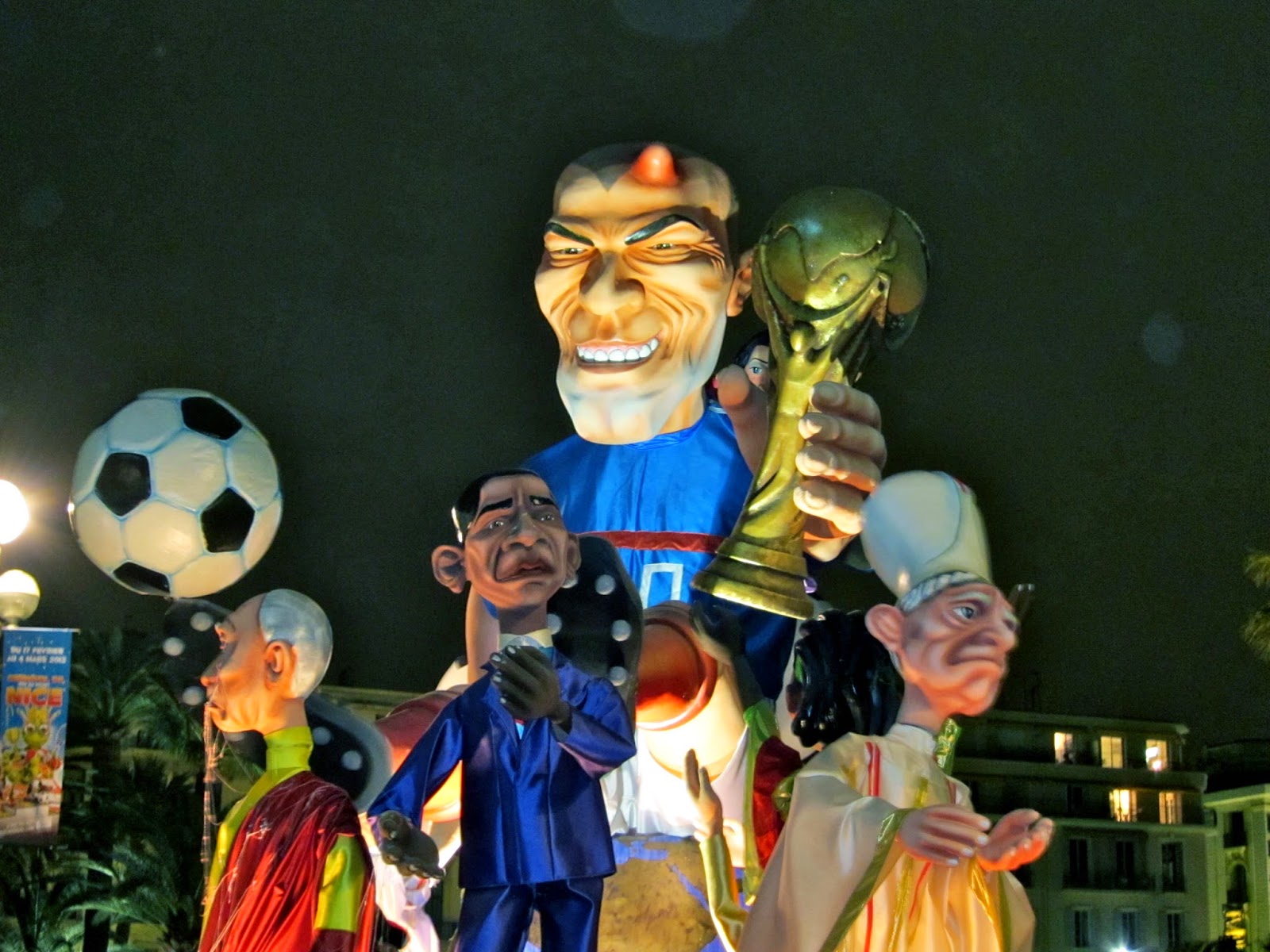
That's Obama and the Pope from a few years back.
 If you want to go for the last couple of days, I suggest you take a look at Best of Nice www.bestofniceblog.com where my friend has brilliantly outlined how to get involved.


I on the other hand will take myself off to my studio for a little "down" time.  Who says I'm "sauvage" ( unsociable)?  

Friday, February 27, 2015

Rules of Etiquette


Mary with French friends, Rebecca and Patrick.  We "tutoyer" each other.   I am the "old" one, so I am flattered. 


You all know by now that one uses "masculine" and "feminine" in the French language.  A lamp is le lampadaire ( masculine) and a table is La table ( feminine).  There is no easy way to learn the differences.   You just have to use all of your memory devices or be here long enough that the right pronouns come naturally to you.  

 The French language also has formal and informal means of addressing a person (as do all Latin languages).  

To " vouvoyer" each other is a transitive verb for formally addressing another.    The informal verb is " tutoyer" and is used in the familiar usage.  There is a big choice to make here if one wants to be respectful in conversation. 

When I first came to Nice and was learning the language, my first instinct was to always use the formal usage just to be on the safe side.  But if you call a young married woman ( of say 23 years) "vous" and "Madame", she may be a little offended.....seeing as how she still looks and feels like a "mademoiselle".  

 As I was attending classes in art and language when I first arrived, it seemed that just being students together , no matter what rank or age, made us all eligible for informality or the "tu" form.  Some older people didn't like the idea that in all of the classroom, you had singled them out with "vous", when they too were students with the rest.  So then I got used to using the informal "tutoyer" at school. 

  But eventually,  I found that my eagerness to plunge in and speak meant that I managed to be correct with my usage only about 50% of the time.  I would hear the "wrong" usage escape my lips before I checked it....because I wanted to speak "at speed". 

One day about three years after I had lived here,  I got a frantic call from a very distinguished Parisienne lady who I will call Monique.  She had retired here with her husband, a doctor and lived in a very elegant apartment ( with a piano that no one played, no less).    She had a very gentile way about her and although we were pals, I always used the formal address when speaking to her.  

"Mary," she said, "I have a problem. You know that new french lady in our group that has just moved from New Caledonia?  Well, she has begun right away to "tutoyer" me and I haven't corrected her.  Maybe that is what they do in " La Nouvelle Calédonie".  I know I have known you a lot longer and I want to give you permission to "tutoyer" me as well. " 

 I just laughed and told Monique " You know I am lucky if I get it right half the time but I am grateful that you don't hold it against me.  I will happily, use "tu" in the future". 

So it does matter to certain French people,  but not so much to others.  Children are almost invariably addressed informally and people much older than oneself almost always are addressed formally.  In some Parisienne homes the children "vouvoyer" their parents I am told.    There are exceptions everywhere one turns but especially in  the "south" where we are more relaxed. 

 A safe rule is to always start with "vous" and wait for permission to use the informal.  And never use the person's first name unless they give it to you as the preferred means of address. 

  But neighbors, or people who you have not been formally introduced to, it is more correct to use Madame or Monsieur without the last name.   The French are very private and especially those of the older generation do not give there names out on the first meeting as one does in America, especially in a work situation.  And in the street even if you know the last name you do not use it....but just say bonjour Madame or Monsieur (unless you are on a first name basis with that neighbor). 

Oh, yes, there are lots of ways to go astray with etiquette. 

 But if you excuse yourself and apologize you will find the French very gracious about your "perceived" mistake.  They are secretly very pleased that you want to learn what they all consider "a very difficult" language.  

And you will win points just for trying......unless that is,  you "butcher" the accent! 

Thursday, February 26, 2015

Observations on a Winter's Day


Today on a sunny winter's day I exit the house dressed with wild melon colored coat and tennis shoes and flowered jeans.  Yesterday I met  with an American, Sunny,  and she was dressed with orange lipstick and a peach colored top and jacket.  Today I ran into my Armenian friend, Silva, and she had on a "orangey" pink jacket and red high tops. 

It is very un-French to dress in bright colors.  Only foreigners dress this way.  The average French person has a variety of black coats and jackets and neutral colored clothes from head to shoe. 

On a serious note,  the recent Charlie Hebo slayings of cartoonists and police in Paris were a big shock to all of us, French and foreigners.  On one level though, the event was not surprising.  I think if you print the kind of scathing satires that Charlie Hebo published.... making explicit and obscene drawings depicting the great figures of all religions....it was just a matter of time before a terrorist/ or group fought back.  

  A most informative article was written by an American living in Nice,  Dana Kennedy.  She points out that one of the recruiters to jihad hails from Nice....in her article found in the Daily Beast.  http://www.thedailybeast.com/articles/2015/01/30/france-s-pied-piper-of-jihad.html   

Now during Carnival we have the largest French police presence in the country going on right now in Nice.  There are young men carrying "serious" guns on the famous market street: Cours Saleya; in front of Galeries Lafayette and walking around in threes and fours all over town.   Other then this addition, I don't see that people's behavior has negatively changed...especially towards muslims .  We did have a recent incident of a man stabbing one of the gendarmes as the assailant exited the tram.    But folks are calm.  The French are perhaps more sanguine, more fatalistic even, than my fellow Americans.  

The children are being escorted to the Carnival these days "deguisee" which you can figure out means: "disguised".  I love how they use that term instead of "in costume".  It is so much more imaginative for the children to be "disguised" even though maybe they are "unrecognizable" only in their own minds.  This new language continues to fascinate me.  

My friend who is new to Nice tells me that she was refused service in the market for not putting her fruits and vegetables in the thin plastic bags provided.  I pointed out to her that the system here is to weigh the fruit, tie up the bag and have the machine or the "fruit and veg. guy" put a price tag on it before you approach the main checkout stand.  

 On an aside to this, at a popular market here,  there is a DIY( Do it yourself) machine for the purpose .  You point to a picture of the fruit or vegetable you are weighing.   But the pictures are not in alphabetical, nor for that matter...in any kind of logical order.   It's easy to mix up a parsnip with a daikon. Too bad,  you just have to know. 

The biggest hurdle for a newcomer settling in France is really not about learning the language.   It's about learning new ways of thinking.  And that is the challenge as well as the joy ( and frustration) of growth in general.... isn't it?